House of David Season 2 Episode 5: Recap, Review, & Analysis

Updated: May 15
Episode 5 of House of David Season 2 depicts David’s growing success and fame as a military leader (1 Samuel 18:14-16) and the final stages of his doomed relationship with Mirab (1 Samuel 18:18), while also continuing to develop the mythos surrounding the Sword of Goliath and the impact of the dawn of the Iron Age. We also learn more about Abner’s troubled relationship with his mother and see how the dynamics of Gibeah have shifted in response to Saul’s decision to isolate Ahinoam and take Kazia as a concubine. Below I'll offer an in-depth recap of the plot (SPOILER WARNING), my opinion of the episode, and an analysis of its key themes. You can also find our video discussion of House of David Season 2 Episode 5 here on YouTube.
How to watch House of David Season 2
You can now watch Season 2 of House of David with a standard Prime Video subscription. However, if you want to support Wonder Project, you can sign up for a 7-day free trial of the Wonder Project subscription (affiliate link). After the trial, the subscription costs an additional $8.99/month on top of Prime Video.
More House of David Resources
Watch House of David Season 2 with a Wonder Project Subscription 7-Day Free Trial (affiliate link)
House of David Season 2 Episode 1: Review, Recap, & Analysis
House of David Season 2 Episode 2: Review, Recap, & Analysis
House of David Season 2 Episode 3: Recap, Review, & Analysis
House of David Season 2 Episode 4: Recap, Review, & Analysis
House of David Season 1 Episode 1 Bible Study & Discussion Guide
House of David Season 1 Episode 2 Bible Study & Discussion Guide
What Happened in House of David Season 2 Episode 5 (God of Swords)?
Jonathan, Abner, & David in House of David Season 2 Episode 5
Episode 5 opens with a montage of David leading his men into battle in a variety of settings and seasons. The montage ends one year after the death of Goliath, with David voicing/crafting the words of Psalm 92 and Psalm 41 on a hilltop. There he is found by Jonathan who is surprised to see him still writing in the midst of all his recent victories. As the two talk, we’re brought up to speed on the past year: David continues to delay his marriage with Mirab, Mychal has given up on romance and is focused on teaching children to read, and Jonathan has given up on romance with Sara, who is allowing the pain behind (her brother’s death) to block the joy ahead and needs to “look forward.”
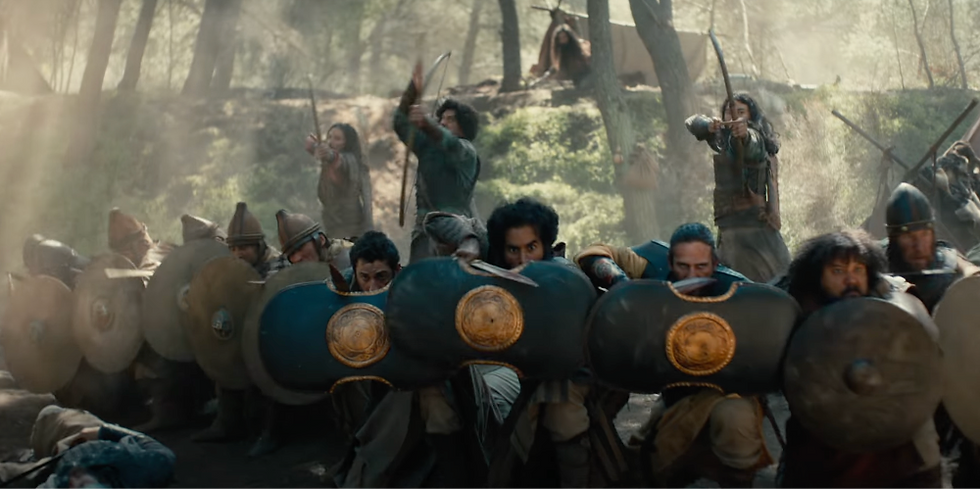
Suddenly, horns alert David and Jonathan to an ambush. Rejoining their men, they find them struggling against the Philistines, who are equipped with superior iron blades that are able to break the Israelites’ bronze arms. Even so, David is able to rally the men and lead them to victory. Along the way, the Israelites recognize the value of the Philistine weapons and begin taking the swords for themselves. The men are unnerved at how the swords have grown lighter and more perfect recently, but David urges them to trust that God is able to defeat even the superior Philistine technology.
Upon their return to Gibeah, Jonathan shows Abner the improved iron swords and they conclude that they will need to discover the secret of the new technology if they are going to keep up with the Philistines. David points out that Goliath’s sword was far better than anything the Philistines are using and wonders what became of it. Rushing off, Abner rides to Nob, where he asks Abiathar to let him inspect the sword of Goliath. There he discovers a mark of the “God of Swords.”
Meanwhile, back in Gibeah, after sparring, Jonathan asks David what it’s like to be anointed (with the Holy Spirit) and David describes it as a source of power and amplified emotion that scares him a little and makes him feel alone. Jonathan assures David that he is not alone. Recognizing that his own anointing means Jonathan will not be anointed, David expresses sadness that the throne will not pass to him as it should have.
Returning to Gibeah, Abner reveals to Saul, David, and Jonathan that the God of Swords who made Goliath’s sword lives in Endor. Initially, Saul forbids Abner from returning to Endor, not wanting his mother, the Witch of Endor, to pull him back into her orbit. Abner insists, however, that he alone will be able to find the God of Swords and must do so with a small task force of warriors. Saul finally relents and sends Abner, along with David, Jonathan, Eliab, Uriah, Oaz, Abinidab, and a few others, all disguised as hooded merchants to avoid drawing attention.
On the outskirts of Endor, Abner warns the men that it is a hive of renegades and criminals. Entering, they find all manner of exotic and immoral behavior: brawling, gambling, idolatry, and dancing. Finding a former contact, Abner inquires about the God of Swords, who he bribes into giving them information. They are then taken to a snake fighting pit, where Oaz bets some of David’s money on a snake (and loses).
Approaching the owner of the pit, the God of Swords, Abner asks to talk to him about Goliath’s sword. Going back to his forge, the God of Swords explains that iron is the only god he worships. Although they offer to pay him handsomely to teach the Israelites how to make iron, he refuses, wary of being trapped. But then Abner pulls out his trump card, revealing that he knows the location of the God of Swords’ daughter, Bathsheba. Their negotiations are cut short, however, when they are accosted by spies and knocked out with strange dust.
Brought in hoods to a secret cave, the Israelites are forced to kneel before the Witch of Endor, a priestess of El, mistress of Baal, sister of Asherah – and Abner’s mother. Abner had promised never to return and now she plans on killing him because of how he has abandoned her gods.
When defied by Eliab, she decides to demonstrate her power by revealing secrets that the dead have revealed to her about each of the Israelites. When she predicts how Jonathan’s life will be cut short and another will have the crown rest on his head instead, Jonathan insists that he only wants the crown to rest on one deserving of it. Turning to David, she recognizes the presence of the Holy Spirit and expresses fear at his power. Nevertheless, she recognizes that he is living in a lie and warns that his power will break those around him and that his house will never know peace. Fearing David, she sends them away alive but warns Abner that Saul’s house will crumple from within while he watches helplessly.
Returning to Gibeah with the Israelites, the God of Swords warns that if Abner doesn’t deliver Bathsheba, he will kill him, his mother, his men, and give the Philistines a thousand swords in spite. Abner promises to keep his words. He also urges the men to forget the words of the Witch, insisting that she only wants to sow chaos and distrust.
Confiding privately in David, Jonathan admits that his heart is disturbed by the Witch’s words and worries about his future. Nevertheless, he realizes that, like David, the only thing he can do is try to live in the truth. Riding off, Jonathan finds Sara picking herbs and rushes in to kiss her. Moved by his passion, she asks him what they will do now.

Eliab & David in House of David Season 2 Episode 5
Eliab is among the warriors ambushed near the start of the episode and has his bronze Amalekite dagger destroyed. Left between the Israelite battle formation and the Philistines, Eliab refuses to listen to David’s orders and has to be tackled to the ground in order to avoid a volley of arrows. After the battle, when David rebukes Eliab for defying orders, his brother replies by rebuking David for telling him what to do.
Eliab is among the soldiers who joins David and Abner in pursuit of the God of Swords, although he continues to show his frustration with his brother openly. Later, when they are captured by the Witch, she demonstrates her power to speak to the dead by revealing how Eliab is haunted by the cries of the innocent family he slaughtered.
Upon returning to Gibeah, Abinidab confronts Eliab about his treatment of David, in spite of how David just saved their lives and has proven himself time and again. When Eliab insists that David is a danger to himself and others, Abinidab questions whether Eliab is actually just resentful of how David has become the hero of the family instead of him and points out that God is the one who chose David.
Mychal, Mirab, & David in House of David Season 2 Episode 5
Having given up on David, Mychal has thrown herself into teaching children how to read and write. As she points out, reading Scripture is how we remember the heroes that came before us and how we can leave stories for those who come after. When one of her students expresses interest in writing the story of David the Giant Killer, Mychal wonders how the story will end.
Upon David’s return, Mirab meets him in the crowd and reminds him of how they need to set a date for their wedding, but David brushes her aside. Looking up, Mirab notices Mychal watching with sadness.
Finding Mychal inside, David recalls how she once taught him to read and appreciated his morning prayers (unlike the late sleeper Mirab). Giving her Psalm 23, he explains that he thinks that it came not from himself but from God. When Mychal questions whether David will write a love song for Mirab as well, he insists that he will not, since it would not be true. Feeling her emotions stirred up, Mychal sends David away, lest he reopen her old wounds.
As he leaves, David is accosted by Mirab, who pushes him more forcefully on marriage planning, insisting that she has waited long enough and that her father’s will won’t change. David finally concedes and agrees to set a date.
Later, after Dinah witnesses Eshbaal and Doeg conferring secretly, she warns Eshbaal against trusting an attack animal, lest he turn on Eshbaal, but her husband dismisses her concern. The two are soon joined by Mirab, who they congratulate on setting a date for her wedding – much to the disappointment of Mychal, who nevertheless congratulates her sister as well.
That night, as Mirab looks at dresses, Ahinoam questions whether she is actually ready for marriage tied to power and status. She insists that Mirab will need to endure great costs without emotion or ease. Unfazed, Mirab insists that she’s learned from Ahinoam that love serves no purpose – a lesson that Ahinoam claims she did not intend to teach. Granting Mirab a ring as a token of her presence, Ahinoam affirms Mirab’s decision, urging her to harden herself with resolve, while also insisting that she does love Saul.
Meanwhile, Mychal is visited by Joab, who Abner has kept back in Gibeah in reserve. Joab flirtatiously asks Mychal for a reading lesson, but Mychal misses the joke, insisting that he already knows how to read. Again, Joab tries to show his interest by pointing out how she’s holding her hands in a way that she often does when worried, and again Mychal misses the implication, explaining that she always worries when David goes out. Oblivious to Joab’s interest, she asks him to do anything he can to keep David safe – an assignment that he dolefully accepts.
After the Witch’s warning about living in a lie, David confronts Saul once again about his impending marriage to Mirab. Refusing to marry her in defiance of the truth, David humbly acknowledges that he is not entitled to Mychal either. After all, he is only a simple shepherd (1 Samuel 18:18). When Saul warns that decisions like this have consequences, David accepts this but insists that lies do as well. As David departs, Saul is left unsettled.

Saul, Ahinoam, & Kazia in House of David Season 2 Episode 5
As Saul watches David return triumphantly to Gibeah, cheered by adoring crowds, Ahinoam appears and wonders how long it will take Saul to forgive her – although Saul insists that she is the one who abandoned his bed and moved across the palace. Seeing David, Ahinoam insists that the people should be chanting Saul’s name and not his. Saul is content to hear the women praise him for killing thousands, though they praise David even more for killing tens of thousands (1 Samuel 18:7). Ahinoam sees this as a sign that David is eclipsing Saul and could be crowned in his place. Though Saul dismisses her suspicion, Ahinoam insists that she is acting as a shield for Saul and his throne.
As Saul sits in his bed chamber, he asks Kazia how his daughters are faring. Now sharing his bed as a concubine, Kazia dismisses his worry, insisting that the girls’ wounds will heal with time. But Saul has the wisdom to recognize that some wounds don’t heal with time, they only fester.
Later, as Kazia works in the servant quarters, she is found by Doeg, who demands the secret of how Saul was made well, insisting that she owes him her life. Kazia haughtily insists that she is no longer under Doeg’s thumb, now that she is a concubine, warning that he owes his life to her whim now.
Achish & Dagonor in House of David Season 2 Episode 5
Back in Gath, Achish and Dagonor boast to one of the Philistine kings how their new weapons will enable the combined Philistine army to conquer the Israelites. Unpersuaded, Ashdod rebukes them for repeating the same folly that just recently bled the Philistines dry and refuses to offer his silver or aid. Furious, Dagonor kills Ashdod. Achish joins Dagonor in seizing the son of Ashdod and urges him to join a new generation of kings in war against Israel – or to suffer his father’s fate. Nevertheless, he rebukes Dagonor for taking such violent action against a fellow king against his own orders.
Review of House of David Season 2 Episode 5 (God of Swords)
Episode 5 is probably the weakest installment of House of David Season 2 so far, but it’s far from bad. A few of its strengths:
Production Value, Costumes, Cinematography, Choreography: House of David continues to maintain the quality of a mainstream historical/fantasy epic. Pretty much everything looks top notch.
David’s Transformation: Episode 5 finally shows David fully stepping into his role as a military leader. Because Season 2 has taken the time to show us his gradual development and the work he’s done to earn the respect of his soldiers (represented by Uriah and Oaz), David’s transformation feels natural and believable. Of course, his actual growth in stature and in favor would have taken longer, so I appreciate the battle montage at the start of the episode. It effectively functions as a “...,” inviting us to fill in the gaps based on the trajectory that we’ve seen so far.
Friendzoning Joab: I found the scene between Joab and Mychal to be delightfully painful and realistic. Mychal is so focused on the well-being of those that she loves that she’s oblivious to all the obvious signs of Joab’s interest. Mirab would be far more aware of her own perception and would see the opportunity – with no obvious path to marriage with David, Joab could provide Mychal with the chance to move on from David. Of course, Joab’s character flaws would probably make such a match difficult in the long run. But I like that the show is hinting at these alternate paths. When David and Mychal’s marriage goes south, we’ll be in the position to wonder about what could have been. And making Joab swear to the woman he loves that he will protect the man she loves – it provides his character with a really interesting wrinkle. Just as he’s done horrible things to protect Saul, Joab will do horrible things to protect David, in fulfillment of his promise to Mychal – in spite of his intense envy. No wonder his conscience becomes so seared.
Mychal’s Future: The theme of looking to the future is quite prevalent and encourages us to identify interesting bits of foreshadowing. I don’t think it’s an accident that Mychal is having difficulty in her relationship with David, Mirab is hearing about the pain of being a royal consort, Saul is isolating his true wife in favor of a younger female servant, and Bathsheba is being mentioned for the first time. The show wants us to be anticipating how David will sadly fall into sexual sin in a way quite similar to Saul and Mychal will find herself shunted off just like her mother. By slowly introducing us to the marital/extra-marital dynamics of ancient kingship, the show is providing us with a frame of reference that will help make sense of when David starts taking multiple wives and concubines. I also think Mychal’s efforts to teach children how to read and her musing about writing the story of David hints at another dimension of her future. Given how Mychal functions as the exclusive frame-narrator for House of David, I think the show is setting her up to be the writer of the Book of Samuel. As I’ve pointed out many times, there’s a clear parallel to Princess Irulan of Dune.
Eliab’s Pain: Out of the Witch’s revelations, the only one that I thought was particularly interesting and on point was aimed at Eliab. The whole point of his story is that he’s been trying to contain his guilt and resentment and that it’s consequently seeped into his relationship with David, so it actually makes sense that it would need to come out in the way that it does. I’ll continue to view his story with interest.
A Wretched Hive of Scum and Villainy: Endor (now sketched with far more detail and imagination than it was in Season 1) is a visually and culturally distinct setting, which the show establishes with flair. I’m glad to see the show stepping outside of its standard set of locations to put David in a very foreign, uncomfortable place.
I did have more issues with Episode 5 than I've had with earlier episodes:
Awkward Transition: Pulling off a time-jump in the middle of a season can be difficult. Andor Season 2 is probably the best I’ve seen it done. Episode 5 doesn’t do horribly, but we do get a few “as you know”-ish moments that feel a little clunky.
Tonal Issues: So far, I’ve been on board for the ways in which House of David draws on fantasy tropes or even makes direct allusions to famous fantasy films in order to position itself as a more epic/transcendent type of Bible adaptation than, say, The Chosen. Even so, I felt like Episode 5 leaned a little too much into fantasy tropes (a mythical smith, a legendary sword, hidden markings, a task force of heroes in disguise, a biblical Mos Eisley cantina with exotic fire-breathers and snake-fighting, a secretive witch with a band of spies with magic dust, a man pressured to do something to save his long lost daughter). Piling all of this stuff into a single episode, with relatively little underlying biblical basis – it was just a little too much and a few steps beyond where the series has been.
Development Ex Machina: The way that the show sent David and his friends on a made-up fetch quest so that they could be caught by the Witch and have her tell each character exactly what he needed in order to move forward in his storyline feels forced and artificial. I would rather have seen David, Jonathan, and Eliab learn their respective lessons through reflective action and not through a deus ex machina. I also just think it’s weird that the witch’s words were generally pretty true and not that manipulative.
Too Many Connections: The world of House of David is beginning to feel a little too interconnected. Bathsheba’s father is the maker of Goliath’s sword, who lives in the same city as Abner’s mother, the Witch who will help Saul. Abner knows all of this – and the location and name of the God of Swords’ daughter. Saul’s servant, Kazia, was adopted by Doeg and also just happens to know Sara’s father from her youth. Sara’s brother was killed while under Jonathan’s leadership. I get that the world at the time was smaller, but some of these connections are beginning to stretch credulity and feel contrived to move the story along.
Sara’s Sudden Turn: I wasn’t a big fan of Sara’s sudden rejection of Jonathan last episode, but I’m even less of a fan of her sudden acceptance of him this episode. Jonathan wasn’t the reason they weren’t together – Sara was. He didn’t do anything wrong – she was just struggling with resentment. It doesn’t make sense for their romantic difficulties to be resolved by Jonathan learning a lesson (which he kind of already learned from Samuel in the last episode). She’s the one who needed to learn/grow/heal. And yet when Jonathan arrives, she embraces him without a second thought – as if she’s just been waiting for him to come around. I don’t like to speculate about the process, but it really feels like some piece of this story got trimmed, either between screenplays drafts or during editing, because this storyline just didn’t make sense to me.
That list of issues may look long, but it didn't prevent me from enjoying Episode 5 or looking forward to the remainder of House of David Season 2 with anticipation. A series like this will inevitably have a weak point, but the overall trajectory of the show leaves me optimistic about where things are heading.
Key Themes of House of David Season 2 Episode 5 (God of Swords)
Episode 5 of House of David Season 2 has a few key themes that I found very interesting:
Forgetting What Lies Behind & Straining Forward to What Lies Ahead
Episode 5 contains the most significant time-jump in House of David thus far and so it’s a natural point for the series to reflect on the nature of time and change. Just as the season itself is trying to leave behind the past and press on toward the dramatic future, several of the characters need to forget the past and move toward a new future:
Mirab wants David to forget his past hopes with Mychal and move forward into the future by setting a wedding date.
Jonathan wants Sara to leave behind her resentment at the loss of her brother in order to move forward in her relationship with him.
Jonathan needs to leave behind his past dream of sitting on the throne and embrace the future God has given him as an ally of David (and a husband to Sara).
Mychal wants to forget the heartache of losing David to Mirab, and so she throws herself into teaching children, who represent the future of Israel. Joab wants her to forget David more fully and embrace him as her romantic future.
Ahinoam wants Saul to forget her past betrayal and move forward with their relationship. But Saul seems more keen on leaving Ahinoam behind in the past while he moves into the future with Kazia.
Kazia wants to leave behind her past fear of Doeg and Ahinoam and is moving forward into a future in which she is the one wielding power.
Eliab wants to leave behind the memory of his role in slaughtering an innocent family but is clearly unable to move into the future without dealing properly with his guilt.
Achish and Dagonor want the other Philistine kings to leave behind the memories of their past failures and move forward by investing in iron weapons and another war against Israel.
Abner needs to leave behind his fear of his mother in order to help Israel find the technology it will need to face the Philistines in future battles.
The God of Swords wants to leave behind his past as a servant of kings but is forced to return to it in order to save his daughter.
While pretty much all of the characters I’ve mentioned want to leave something behind in order to move into the future, forgetting the past is not always the best way to move into the future. In some cases, the only way forward is to face what lies behind. Eliab can’t keep running from his past guilt – he needs to deal with it properly if his relationship with his brother is going to have a future. Abner can’t keep running from his mother – he needs to go back to Endor to face her in order to fulfill his calling. If Saul and Ahinoam tried to work through their past issues, they might be able to have a future together. Mychal and Mirab need to work through Mirab’s past betrayal if they are going to have a future. Achish’s future plans will fail because he hasn’t learned from his past failure. As Saul points out to Kazia, time doesn’t heal all wounds – in some cases it just causes past wounds to fester.
The Witch of Endor fits into this theme in an interesting way. As someone who (ostensibly) speaks to the dead, she has a unique degree of access to the past. That appears to be why she also has a unique insight into the future that lies ahead for several of our main characters. But the Witch’s focus on the past also makes her dangerous. She’s so consumed by her anger at Abner that she almost slaughters her own son. Fortunately for our characters, this creature of the past quakes in fear when in the presence of the living God, who was and is and is to come.
God, with his insight into past, present, and future, provides the only reliable guide to the future in Scripture. As Mychal explains to her students, it is by confronting the sacred stories of Israel’s past that God’s people are able to find the strength and wisdom they need to move forward. Indeed, this was quite literally true in Season 1, when David found the strength he needed to face Goliath by reflecting on the story of Joshua. Of course, by watching House of David, viewers are reflecting on the past, and the show clearly wants to offer them encouragement and wisdom to face the future.
(Not) Living in the Truth
Although Episode 5 encourages us to exercise caution in listening to the words of the Witch, it does seem to affirm her warning against being weakened by lies and her exhortation to live into the truth. We see this theme come up in several situations:
David’s relationship with Mirab is predicated on a lie. He doesn’t truly love her or want to be with her – he’s just bowing to the will of the King (and trying to keep her from embarrassment). Recognizing this, David finally has the courage to turn down the marriage offer from Saul, knowing that the consequences of living in a lie would outweigh the consequences of defying the King.
Mirab’s effort to marry David also appears to be based on a lie. When Ahinoam cautions her about the union, Mirab dismisses the importance of love. We’re left to conclude that her pursuit of David is solely driven by a desire for status and power. Mirab assumes that this is how Ahinoam views her relationship with Saul, but Ahinoam insists that she does indeed love him. Kazia’s embrace of Saul, on the other hand, clearly is driven by a desire for power and does not reflect true love.
Eliab is also being weakened by a lie. He’s a noble man, but his efforts to cover up his guilt and frustration are warping his soul. Hopefully his conversation with Abinidab near the end of the show will push him to let go of that lie and embrace the truth, as painful as it may be.
For Jonathan, denying his love for Sara is also a lie. His decision to go to her at the end of the episode represents a decision to embrace the truth of what he feels, even at the risk that he may be rejected.
We get several more hints that Eshbaal’s relationship with Dinah is predicated on a lie. He and Doeg are clearly up to something. Eshbaal’s unwillingness to be forthright with his wife prevents the two from having a proper relationship.
Episode 5 presents us with two opposing viewpoints. Some characters, like Mirab, see love and emotion as a source of weakness and instead live a lie, accepting inauthentic relational dynamics in order to pursue power or avoid shame. Others, like David, see lies as the true source of weakness and choose to live in the truth, pursuing relationships that truly matter. Episode 5 clearly favors truth and love over lies and the avoidance of shame and weakness, but it’s also honest. There are often uncomfortable consequences that result from living in the truth – as David is about to discover.
Stay tuned for more content on House of David Season 2. Also be sure to check out my blog review, recap, and analysis of Episode 1, Episode 2, Episode 3, and Episode 4 as well my discussion of House of David Season 2 Episode 5 on YouTube.
Supporting The Bible Artist
Have my resources helped you explore and enjoy House of David? My resources are used by thousands of Christians like you, as well as church communities and ministries across the globe. You can help my work continue through a one-time gift or recurring support*.
*Members who contribute $5/monthly or $50/annually receive access to exclusive content, including monthly blogs and pdf versions of my Bible study/discussion guides, as well as free gifts and other perks.
Go Deeper
An adaptation like House of David isn't meant to replace the Bible; it's meant to drive us deeper into the Bible and spiritual reflection. Some of the biblical advisors for House of David have published a series of devotionals that are meant to explore some of the Scripture and biblical themes that inspired the show and help viewers apply them to everyday life. If you're looking for additional resources, you might want to check them out!

FYI: As an Amazon Associate, I earn from qualifying purchases. Click here for my affiliation policy.


Help, somebody! Can someone shed some light on the Witch of Endor?
I am confused, because Abner, in season 1, refers to Besai as "mother." But wasn't Besai, a witch from Endor, stabbed to death just a couple of episodes ago, after Ahinoam banished her from Gibea?
I was tempted to believe that Besai didn't really die -- but then we have the grievances of the Witch of Endor in episode 5, where she looks at the Israelites, and declares "You killed a daughter of Endor, in order to cover up your own sins".
Does the Witch of Endor have more than one life? How can both of these women be Abner's mother? Is this a shape-shifting trick, or wh…
Thank you for your recap and analysis. A good balance between appreciation and criticism.
I agree that the Jonathan and Sara subplot is the most baffling part of season 2 so far, though I am more positive towards its continuation in this episode rather than being dropped and forgotten in episode 4 as I initially expected. While the themes entwined within are heartfelt it gives me the impression that in a story full of characters this subplot is just there to give Jonathan something else to do.
Eshbaal has pleasantly surprised me so far this season when his character seemed quite one-note last season. He is scheming for power and entwined with pagans, but just how devolved into evil he…