Daniel and the Fiery Furnace: Movie Recap & Review

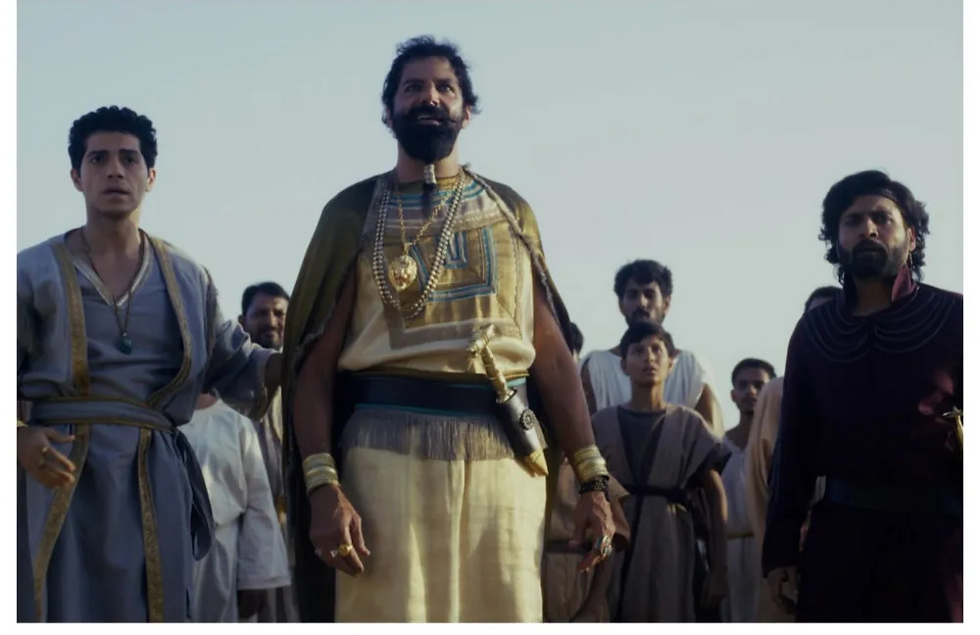
Daniel and the Fiery Furnace is a new Bible movie adapting Daniel 1-4:3, the struggles of Daniel (Mena Massoud) and his friends, Shadrach, Meshach, and Abednego during their exile in Babylon under the reign of King Nebuchadnezzar (The Chosen fan favorite, Elijah Alexander). While the biblical stories about Daniel and his friends not eating the king’s food, revealing his dreams, and refusing to worship the golden statue of Nebuchadnezzar are territory well-tread by Sunday school lessons and Bible storybooks, Daniel and the Fiery Furnace sets these familiar episodes of courage and faith in the context of the first conquest of Jerusalem and the ministry of the prophet Jeremiah. Below I'll give a summary of what happens in the film and then review Daniel and the Fiery Furnace. You may also want to check out my recent interview with Daniel and Matthew Kooman, the film's writer-director team, and my YouTube discussion where Victor and I review Daniel and the Fiery Furnace.
What Happens in Daniel and the Fiery Furnace? (Plot Summary)
The film opens with a frame narrative, in which a wise storyteller, on his way from Babylon to Jerusalem, regales his fellow travelers with the story of Daniel’s courageous faith.
His story begins in 605 BC, during the final days of the reign of King Jehoiachim [although later events from the reign of Zedekiah (Jeremiah 27) are retconned in]. Daniel and his three friends, Hananiah, Mishael, and Azariah (soon to be renamed Shadrach, Meshach, and Abednego), are established as the faithful remnant of believers under the leadership of the prophet Jeremiah, whose exhortations and warnings are rejected by the wicked king Jehoiakim (Jeremiah 36).
The army of King Nebuchadnezzar of Babylon descends upon Jerusalem in order to punish Jehoiakim for joining forces with Egypt, in rebellion against Babylon and, more importantly, God. Nebuchadnezzar personally makes an example of Jehoiakim for all to see, while his armies plunder the city and take captive the local elite. While Jeremiah is called to stay and continue to prophesy against Jerusalem, Daniel, his friends, and Jeremiah’s sister, Susannah, are among those taken to Babylon, carrying scrolls of Scripture in the hems of their robes.
As the procession of Judean captives are led along a desert road to Babylon, one man tries to escape but is soon eaten by a lion. Later that night, a lion makes its way toward the tent of King Nebuchadnezzar but is spotted and stopped by Daniel. Although the King is a little offended by Daniel’s exclusive commitment to the biblical God, in gratitude he renames Daniel Belteshaazzar and asks for him to be included in his retinue of wise men.
Upon arriving in the shockingly pagan city, Daniel and his friends are invited to eat from the king’s idol-dedicated food and indulge their sexual appetites for ten days. After that, they are to be castrated, so they can serve in the king’s house as non-threatening eunuchs. Despite the worries of Ashpenaz, the Chief Eunuch, Daniel and his friends refuse to defile themselves with unclean food and sexual immorality, insisting that they will grow stronger, not weaker, by remaining faithful. As the day approaches, Daniel’s resolve is strengthened by Susanah, who promises to send him word if Jeremiah has a message. At the end of the ten days, Nebuchadnezzar and Ashpenaz are astonished to see that Daniel and his friends have put on more weight than any of the other recruits and the four men are accepted into the king's service.
That night, as Daniel and his friends are being castrated, Nebuchadnezzar’s sleep is disturbed by strange dreams. Summoning his wise men, he demands that they help him remember his dream and make known the meaning of it. When one wise man objects that this is impossible, the King pours hot wax over his face and threatens to burn all the wise men unless they meet his challenge.
When Daniel and his friends find out, they pray and the Lord swiftly reveals to Daniel both the dream and its meaning. Arriving just before Nebuchadnezzar can start laying into the Magi, our heroes recount the King’s dream of the statue of gold, silver, bronze, and iron being smashed by a rock that grows into a mountain. As they explain, the Lord is revealing how Nebuchadnezzar’s Babylonian kingdom will be followed by three more kingdoms (i.e. Persia, Greece, and Rome), the last of which will be shattered by the advent of the Kingdom of God. Impressed, Nebuchadnezzar spares the Magi, praises God, and elevates Daniel to his right hand.
Unfortunately, it soon becomes apparent that Nebuchadnezzar has misunderstood the implications of his dream. He decides to build a giant statue like the one he saw as a monument to his power and invites Daniel to serve as its chief architect, using the gold taken from Solomon’s Temple. Daniel accepts the task and appears to receive a vision of how to execute it. When his friends question why he is helping make the statue of a pagan king, he insists that it’s an opportunity for them to show their faith by standing for the truth and refusing to bend a knee to a false god.
Back in Judah, Jeremiah finishes his letter of instruction for the exiles in Babylon. As he begins producing copies of it, he sends Habbakuk to Babylon to encourage Daniel and his friends.
Back in Babylon, the disgraced Magi, resenting Daniel’s ascent to power, devise a scheme to bring him down. They convince Nebuchadnezzar to require all of his subjects to bow down to his statue whenever music is played.

Later, as they anticipate the unveiling of the statue the next day, Nebuchadnezzar and Daniel have a heart to heart. The King reveals his deep desire to prove himself to his beloved father so that he can be beloved. Daniel explains how he and his friends have the same deep love for their God that Nebuchadnezzar has for his father and must surrender all to him. Nebuchadnezzar asks Daniel to teach him the ways of his God, not even realizing the test he is about to put them through.
Anticipating the trial that his friends are about to be put through, Daniel encourages them to see it as a refining fire. Finding Susanah, he asks her to pray with him. As they are praying, Habbakuk arrives to deliver a word from the Lord.
The next day, when the statue of Nebuchadnezzar is unveiled, the King is appalled to see that all of his subjects have bowed, except for Shadrach, Meshach, and Abednego (sitting at Nebuchadnezzar's right hand, Daniel isn't expected to). Calling them forward, he gives them one last chance, warning what will happen if they refuse to bow. When they remain standing, he orders the furnace to be heated (killing a servant) and for them to be sent in.
When the three enter the fire, they're surprised to find that they are unscathed – except for the ropes binding them. Then, to Nebuchadnezzar’s astonishment, a bolt of fire descends from heaven into the furnace and a fourth figure, like a son of the gods (whom viewers will easily identify as the preincarnate Son), appears among them. After embracing and bowing before this true image of God, the three are called out, reunite with Daniel, and the Son ascends back into heaven. Finally humbled, Nebuchadnezzar praises the God of Israel.
Not long after, Jeremiah’s famous letter of encouragement finally arrives, calling the Israelites to multiply and seek the peace of Babylon as they wait for the 70 year sentence of their exile to be fulfilled. Meanwhile, Daniel takes a bit of the gold and fashions it into a cross.
Back in the frame, the wise man concludes his story by revealing that he is bearing the same cross of gold – a gift that he is bearing to the newly born king in Bethlehem (i.e. Jesus).

Daniel and the Fiery Furnace Review
Daniel and the Fiery Furnace is a difficult film to review. Impressive in its scope and ambition and yet ultimately unable to fulfill its potential due to the limitations of its budgets and crew. Buoyed by two strong lead performers and yet burdened by a lackluster secondary cast. Thoughtful and earnest in its engagement with Scripture and yet marred by one very troubling use of creative license. Oh and it leans AI extensively, which some viewers will deem unforgivable, others resourceful, and still others (like myself) ambivalent. It's the kind of film that I want to support because I can see the heart, effort, and potential of its filmmakers and yet I can't recommend it without significant caveats.
Let's start with the positive though:
Biblical Fidelity: Daniel and the Fiery Furnace follows its biblical sources (1 Kings, Jeremiah, Daniel, Habbakuk, and Matthew) fairly closely. When it does add to the story, it’s typically filling in historical detail (e.g. the journey from Jerusalem or Daniel’s presumed castration), explaining a detail in the biblical text (e.g. Daniel’s Babylonian name), or connecting the dots between concurrent biblical texts (especially Jeremiah and Daniel). Even when it depicts characters praying, it generally relies on existing prayers from the Psalms or elsewhere rather than inventing prayers.
Biblical Connections: The text of Daniel is nestled in a complex, extensive network of intertextual connections to prior, contemporary, and future biblical texts. The film works hard to highlight these connections both through its frame narrative/narrator and through dialogue. Although I could have done with less of the frame narrative, I appreciate the incorporation of the Magi. Helping non-scholars see Daniel’s place in the larger narrative of Scripture and shift away from seeing it as a set of isolated moral parables could be one of the film’s more significant contributions to the church.
Nebuchadnezzar and Daniel: The film’s story centers first and foremost on the relationship between Daniel and Nebuchadnezzar. Fortunately, Elijah Alexander delivers the film’s strongest performance as Nebuchadnezzar. While Nebuchadnezzar would have been even more interesting if the film had taken more time to focus on the political and religious dynamics of Babylon, Alexander works with what he's given. While clearly enjoying opportunities to indulge in maniacal tyranny, he also brings a much needed sense of vulnerability and humanity to the character. The titular Daniel is a far less interesting character – the whole point of the story is to show how he remains steadfast – but he works well enough as a foil in his scenes with the King. Massoud captures Daniel’s earnestness and faith passably well.
Audacity and Resourcefulness: Nebuchadnezzar praises (the prophet) Daniel for his audacious heart, but the same praise could go equally to (the writer/director) Daniel Kooman and his brother Matthew. Period films typically cost a lot to make – especially when they involve a big battle, a complex cultural-political setting, and several large set pieces (Jerusalem, the Babylonian gates, the Babylonian palace, and the golden statue). I applaud the Kooman brothers and their team for not cowering in the face of such a heavy lift, despite their limited crowd-sourced budget, and trying to find resourceful ways to fulfill the demands of their story (e.g. filming in India, using AI for establishing shots and armies). No one should doubt the effort or courage that was put into the film.

Though the filmmakers are undeniably well-intentioned, it's the job of an honest reviewer to evaluate not just their intentions but the resulting product. Unfortunately, the Daniel and the Fiery Furnace is not without blemish:
Daniel, the Idol-Maker: Readers of The Bible Artist know that I'm pretty open to instances of creative license in biblical adaptation. But even I was troubled by the decision to make Daniel the architect of Nebuchadnezzar's golden statue. Though Daniel encourages his friends to stand and not bow before it, he is nevertheless consciously making an idol, in clear violation of the Second Commandment (Exodus 20:4-6). I wouldn't have minded it if Nebuchadnezzar tricked Daniel, promising not to use the statue for idolatry. Or I even would have been okay with Daniel participating in a brief lapse of courage/faith that he eventually repented of. Instead, the film makes Daniel completely aware of Nebuchadnezzar’s intent for the statue, while justifying his participation in its creation by suggesting that he is responding to divine inspiration or prompting. But that just makes things worse. First, because it makes God responsible for temptation and a serious sin. And second, because it suggests that it's sometimes acceptable to sin, as long as one believes that it is part of God’s plan. I get how the film wanted to involve Daniel in the golden statue story and show him in his role as Nebuchadnezzar's vizier, but this wasn't the way. For a movie that was otherwise so determined to follow Scripture closely, it's a rather disappointing and baffling creative decision.
Biting Off Too Much: There's a reason why you don't see many historical epics that are indie or crowd-funded. And there's a reason why major studios rarely give historical epics to young directors. To do this kind of movie right takes a lot of money and a lot of experience. As generative AI becomes more competent, it's tempting to think that it will eliminate the demands of such intensive genres. Unfortunately, Daniel and the Fiery Furnace makes it clear that this is not (yet) the case. The AI works in some cases (often for establishing shots and scenery and sometimes for creating crowds), but is always pretty obvious and at times cringey and distracting, particularly when it's used alongside the human characters. And AI can't mask or make up for all the limitations of the production (more on those below). So, as much as I give the team credit for boldness, I have to question the wisdom of attempting to bring to life such a complex story world with such limited resources and experience. If you're a young, crowd-funded creative team intent on adapting a biblical story, I think you want to start with a smaller, more personal story in a single, more mundane environment (Season 1 of The Chosen is a good point of comparison).
Production Value: The limitations of the budget are uncomfortably apparent at several points in the film. The fight choreography is off. The costuming is cheap (Nebuchadnezzar's faux leopard skin robe is particularly bad). Much of the secondary cast lacks subtlety and charisma. The sound design off (the drumming on screen doesn't match what we hear). I try to be a charitable viewer but I just couldn't help but be distracted by so many glaring issues.
Side Stories: The film works best when it's focused on the relationship between Daniel and Nebuchadnezzar. Unfortunately, there are several side stories that steal time from our leads and never really amount to much: most of the frame (we really just need the start and end, not the bit with the thief), Jeremiah and Habbakuk (I'm not sure if the film really needed to include Jeremiah at all, but if so, it could have had just a couple flashbacks and the prophecy at the end), and Susanah’s relationship (I think?) with Daniel.
More Context Needed: The film should either have cut the siege of Jerusalem altogether (beginning instead on the road) or it needed more time to help us understand what was going on and appreciate the emotional significance. It gives only hints of the political dynamic between Babylon, Judah, and Egypt and of the spiritual dynamic in Jerusalem (e.g. the years of idolatry, the presumption Jerusalem was inviolable). Without that context, it's hard to get invested and there are also points that will baffle uninformed viewers (why did God tell Judah to surrender to a pagan king?). I also think it would have helped to have been given a little more understanding of the political dynamics in Babylon itself. What other external threats was Nebuchadnezzar worried about? What internal factions did he have to wrangle? Did he have potential rivals that he was on guard against? I really would have preferred if the film spent time exploring these kinds of issues (through the prism of Neb’s relationship with Daniel) instead of wasting our time on boring subplots.
Performative Prayer: Prayer is a little like sex. It's an intimate act and not meanr to be performed for spectators. And like sex, it’s usually best for films to cue the audience in with a small hint. Sometimes more prayer is justified – like when it reveals how a character is internally wrestling with God (e.g. Simon Peter in The Chosen Season 1 Episode 4) or how a character has grown and changed (e.g. David repenting in House of David Season 2 Episode 4 or the disciples finally trusting God in The Chosen Season 2 Episode 7). But the long prayers in Daniel and the Fiery Furnace don't really feel like a window into the internal conflict or growth of the characters. They just feel like showy performances of faux piety. It calls to my mind Jesus’ warning against ostentatiously praying before others like the hypocrites (literally: “actors”).
The Three Friends: One of the virtues of a biblical adaptation is that it allows you to individualize characters that the biblical narrative treats as a faceless collective (e.g. the disciples in The Chosen). Unfortunately, the film didn't do much to distinguish Daniel’s three friends, which made it hard to care much about them.
I don't enjoy trashing the product of another creator's hard work and sincere devotion. But as much as I respect the Koomans and want them to prosper in their effort to make more Bible films, I also take seriously my role as a critic. While many viewers will focus on the heart behind Daniel and the Fiery Furnace and turn a blind eye to its many blemishes, it's my job to offer readers an honest and as objective as possible appraisal of the films I review. Daniel and the Fiery Furnace may be sincere, scrappy, and (mostly) biblical, but that doesn't make it an engaging or effective movie. I hope it gets enough viewers and support to allow the Koomans to continue their work and fine tune their approach, but I wouldn't exactly classify it as a must-see, especially given the rich landscape of contemporary biblical media.
Supporting The Bible Artist
Has my content helped you explore and enjoy Bible adaptations? My resources are used by thousands of Christians like you, as well as church communities and ministries across the globe. You can help my work continue through a one-time gift or recurring support*.
*Members who contribute $5/monthly or $50/annually receive access to exclusive content, including monthly blogs and pdf versions of my Bible study/discussion guides, as well as free gifts and other perks.


Comments