The Faithful: Women of the Bible Episodes 1 and 2 Recap & Review

Updated: Apr 23
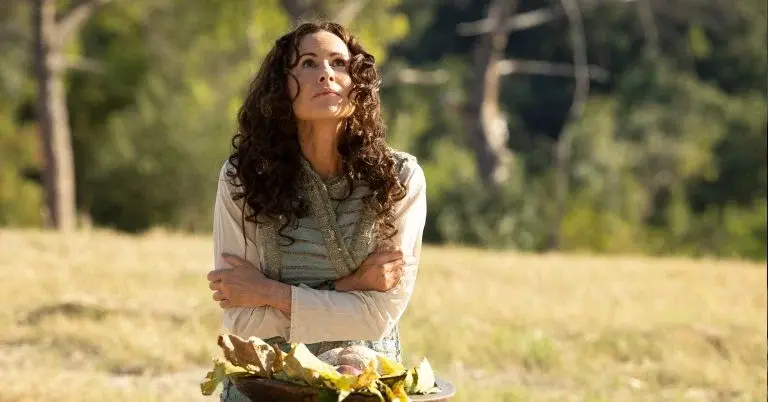
Critics often accuse the Bible – and especially the Old Testament – of being misogynistic because of how the women of Scripture seem to exercise less agency than their male counterparts. Fox’s new Bible mini-series, The Faithful: Women of the Bible, seeks to address this concern by retelling several important biblical stories from the perspective of the key women involved. Episodes 1 and 2* of The Faithful cover Genesis 12-23 – what is traditionally seen as the story of Abram/Abraham – but primarily focus on the perspective of Sarai/Sarah (played by Minnie Driver), the wife of Abram/Abraham (played by Jeffrey Donovan), and their servant/concubine, Hagar (played by Natacha Karam). Below I’ll offer a partial summary of The Faithful Episodes 1 and 2 (to avoid spoilers) and then share my reaction and review. You can also watch my interview with Rene Echevarria, one of the creators of The Faithful here.
*Note: An earlier form of this post only referred to the content of both Episodes 1 and 2 as Episode 1, because the early screening version I received presented the story of Sarai and Hagar as a single continuous episode.
The Faithful: Women of the Bible Resources

Summary of The Faithful Episodes 1 and 2 (“The Woman Who Bowed to No One” and "The Woman Who Talked to God")
Episode 1 begins with a flashforward to the first encounter between Sarai and Hagar, as the Egyptian Pharaoh, accompanied by Hagar, is rowed down the Nile and passes Sarai, who refuses to bow to him. The narrator (Hagar) explains that she was searching for freedom, while Sarai was searching for faith.
Jumping back in time, we meet a younger Sarai in Haran. Her father is trying to arrange a marriage between her and a rich jerk, but Sarai refuses, angering her father and the suitor. Though poorer, Abram asks for her hand instead, demonstrating his thoughtfulness by offering her a blue shawl that she was unable to buy earlier.
Skipping ahead 25 years, Abram and Sarai have a happy but childless marriage – but Abram assures Sarai that he has no intention of taking another wife, as they continue to move through life shoulder to shoulder. That night, Abram is woken by someone calling his name. Following the call outside, he receives God’s famous promise (Genesis 12:1-3). Though Sarai is reluctant, she agrees to support her husband in his call to leave their home and family and to travel into the unknown.
Unable to stay in Canaan because of a famine (Genesis 12:10), Abram and Sarai continue on to Egypt, bringing us back to the opening scene. When Pharaoh sees that Sarai is unwilling to bow before him, he orders his guards to seize – Abram arriving just in time to see her taken away (Genesis 12:15).
When Sarai is brought before Pharaoh, he is intrigued by her spirited nature. After she insists that Abram is her brother, not her husband, Pharaoh plans on wedding her, giving her Hagar as a gift. As Hagar prepares Sarai for Pharaoh, Sarai confesses to her that she is married but hopes that this will provide Abram an opportunity to find a wife who can give him a child and fulfill God’s promise. Before Pharaoh and Sarai can sleep together, however, God intervenes miraculously. Terrified, Pharaoh banishes Sarai and Hagar, fearing that she is a witch (Genesis 12:17-20).
After Abram and Sarai are reconciled, Hagar agrees to join them, taking a stone from the Nile, intent on returning one day. Back in Canaan, Hagar tries to help Sarai get pregnant using folk medicine/superstitious techniques. When God appears to Abram again and promises to multiply his offspring (Genesis 15), Sarai becomes convinced that God brought Hagar into their life so that she could help fulfill the promise by serving as a concubine for Abram. Abram and Hagar reluctantly concede to Sarai’s plan, with Hagar signing an agreement recognizing that the child will legally belong to Sarai. Not long after they begin sleeping together, Hagar conceives (Genesis 16:1-4).
To avoid spoiling anything, I’ll stop my summary here. Of course, you can get a broad sense of where Episodes 1 and 2 are going if you read Genesis 12-23, but The Faithful does work a few significant twists into the received narrative. Note: my review below will reference the remainder of Episodes 1 and 2 in order to share my thoughts and reactions.

Review of The Faithful: Women of the Bible Episodes 1 and 2
Last year we saw a huge wave of biblical media with a diverse range of genres, forms, and approaches. The Faithful continues this trend, representing a form of biblical storytelling that isn’t exactly new but hasn’t played a major role in the recent wave of Bible shows: the woman’s drama. Perhaps more significantly, The Faithful is the first Bible show produced by a mainstream studio since the success of The Chosen. Fox’s decision to begin with a female-centered Bible show probably isn’t an accident – females, middle-aged and older, seem to be one of the best represented demographics in The Chosen fanbase. If Fox is able to tap into the same fanbase that has made The Chosen such a big hit, I imagine the wave of biblical media will only grow.
As a student of Bible adaptation, I was interested to see how The Faithful would interact with Scripture. But as a male in his thirties, who generally gravitates towards genres that are either cerebral, suspenseful, or action-packed, I don’t think I am the ideal audience for the slower-paced and lower-stakes plot of The Faithful. And that’s fine. I’m happy to be in a time when there are Bible shows being produced for audiences that want to engage with Scripture but don’t share my specific taste. Having acknowledged where I’m coming from, however, I still have thoughts on what The Faithful does well and where it struggles. Let’s start with the positive:
The Story of the Matriarchs: Telling the story of the “Patriarchal Period” from the perspective of the Matriarchs isn’t a brand new idea. Many Bible- adjacent novels are driven by a similar impulse, most famously, The Red Tent and its adaptation (though conservative believers will find its posture toward Scripture less palatable than The Faithful). There’s a reason why this concept is popular: modern readers of Scripture are naturally curious about the female heroes of the faith, whose stories receive far less attention in the biblical narrative than their male counterparts. I’m glad to see a new effort to meet this demand generated by believers (creators Carol Mendelsohn and Rene Echevarria are Jewish and Christian, respectively).
Challenging Assumptions: It’s easy to picture Hagar as a home-breaking seductress and Sarai as a helpless victim or a heartless schemer. But Scripture hints at a more dynamic and complex relationship between Sarai, Abram, and Hagar. There’s no hint in Scripture that Hagar seduces Abram or that Abram takes her against Sarai’s will – on the contrary, it is Sarai herself who has the idea of offering her to Abram (Genesis 16:3). The Faithful plausibly imagines a congenial relationship between Sarai and Hagar prior to that fateful decision.
Hagar: Out of the lead performers, I found Hagar to be the most interesting and compelling. Perhaps that’s because she was given the most complex set of conflicting desires (i.e. the desire to remain faithful to Sarai vs. the desire to return to Egypt vs. the desire to remain with her son vs. the desire to expose her true relationship to him).
Sarai’s Failure: The Faithful correctly identifies Sarai’s decision to give Hagar to Abram as an effort to fulfill God’s purposes through human means instead of waiting with faith. This is one of the core theological/moral themes of the original story, and so I’m glad to see it articulated clearly.
Respect for Scripture: I have a few bones to pick with Episodes 1 and 2 of The Faithful, but I still believe that the posture of the show toward the biblical source material is fundamentally respectful. The departures that it makes are relatively small in scale and do not represent a major theological or moral subversion of Scripture. That’s not something one can take for granted when it comes to studio-based biblical media – especially when it comes to a story like Sarai’s. I appreciate Fox’s decision to greenlight a project created by Jewish and Christian believers, and the care that Rene Echevarria took to research the biblical world.
Biblical Connections: I appreciate how The Faithful makes an effort to tie in other biblical stories by having Abram/Abraham recount the tale of Cain and Abel and of the Flood. It’s a good reminder of how this narrative is tied into a larger biblical context and an encouragement to apply this story to life, just as Abram is applying past tales to his own. Moreover, it provides a plausible explanation of how such stories eventually came to be handed down to Moses.
As I’ve alluded to already, I do have a few problems with Episodes 1 and 2 of The Faithful:
The Woman Who Bowed to No One: The title of Episode 1 and the characterization of Sarai in this manner is a strange choice. I suspect that it’s a way for The Faithful to overcome the biases that many viewers will have toward the Old Testament and to position itself as a story of female empowerment. If that’s the type of story the creators wanted to tell, however, I don’t see why they chose to focus on Sarai. The Bible has female figures who could more easily be characterized in this way (e.g. Deborah/Jael). I just don’t see anything in the biblical depiction of Sarai that suggests this would have been one of her defining traits. Indeed, later biblical writers emphasize Sarah’s submission and obedience to Abraham (1 Peter 3:5-6). I don’t think that means she was a doormat – Sarah has no problem making her opinion heard, even if it went against Abraham’s (e.g. Genesis 21:10-11). But she also is willing to defer to her husband’s (often poor) judgment, like when he tells her to say they’re siblings and not married (Genesis 12:11-12). The effort to make Sarai into “the woman who bowed to no one” ends up feeling forced and artificial.
Milquetoast Abraham: I found Abram/Abraham to be quite boring. Domestic stories like this are driven by interpersonal conflict. That’s not to say that the show needed to make Abraham into a jerk to spice things up. In every marriage, conflict emerges when conflicting values are exposed by the need to make difficult choices. By making Abraham overly compliant and deferential to Sarah, the show robs itself of some needed drama – and the opportunity to explore deeper values. It also kind of feels like the only reason why Sarai is drawn to Abram is because he’s relatively nice. Abram’s faith feels like a weird hobby/career decision that Sarai entertains, not a compelling vision that she genuinely respects (even if she struggles to hold onto it herself).
Reassigning Agency Means Reassigning Blame: In Episode 1 of The Faithful, when Sarai tells Pharaoh and later Abimelech that Abram is her brother and not her husband, it’s her own idea, carried out for her own reasons. In the Bible, it is Abram’s idea, carried out for Abram’s reasons (self-preservation). Dramatically, I can see why the show wants to emphasize the agency of its main character. In doing so, however, it whitewashes the situation, making Abram look better than he actually was and oversimplifying the complex situation that Sarai was actually put into. This is the type of situation that could have generated some real conflict between Sarai and Abram, both before and after the kidnapping (can you imagine the argument you would have, if your spouse urged you to deny that you were married?). Also, I get that the show wants to emphasize the agency of female characters, but is it worth emphasizing Sarai’s agency if it means all the blame to her?
The Sacrifice of Isaac: I get that the show couldn’t cover everything in this section of Scripture, especially events that primarily involved Abraham and not Sarah. For example, omitting the story of Abraham saving Lot from the Kings of the East (Genesis 14) makes perfect sense. But I found the decision to not include the sacrifice of Isaac, even indirectly, to be baffling. Sarah was not present, so it makes sense that we didn’t see the journey or the sacrifice itself. But we could have gotten a moment before and/or after the journey. One reason why the omission is significant is because it ties into the story of Sarah, Abraham, Hagar, and Ishmael. Many commentators have noticed that God tests Abraham by asking him to kill his “only” son (Genesis 22) almost immediately after Sarah tests Abraham by practically asking him to kill Hagar and his other son, Ishmael, in order to guard Isaac’s birthright (Genesis 21). Even after receiving her miracle child, Sarah still seems to be relying too much on human means to achieve God’s purposes, and so God forces the couple into a situation where they have to relinquish all control and trust fully in his mercy and power, not in their own cunning. By omitting the sacrifice of Isaac entirely, The Faithful loses all of this rich significance.
A Not So Noble Lie: I’m not a fan of the twist that Episode 2 invents in order to make Sarah’s decision to exile Hagar and Ishmael more palatable. Just because God tells Abraham to listen to Sarah and exile the two doesn’t mean that Sarah’s decision was made with good intent – God just seizes the opportunity to show Abraham how he can bring life out of death and good out of evil, in order to prepare him for the test involving Isaac. Reframing Sarah’s decision obscures the parallels between what she does to her Egyptian slave and what the Egyptians later do to Sarah’s enslaved children. Moreover, it muddles the main theme at issue in the story (i.e. taking God’s will into your own hands).
The Big Picture: Although Episodes 1 and 2 of The Faithful include allusions to other biblical stories, they don't do enough to connect to the meta-narrative of Genesis and of Scripture. The story of Abraham and Sarah is not just a story about a couple struggling to have faith in the face of infertility. It is the beginning of God’s redemptive response to the fall of mankind and the corruption of the nations. Without a sense of the larger issues that are at stake, it’s harder to empathize with the decisions made by the characters. Few of us are going to be in a domestic situation quite like that of Sarah, Abraham, and Hagar. But we probably will face moments when we’re tempted to do bad things for the greater good of fulfilling God’s purposes.
Zing: The Faithful is competently made but I don’t think it has the zing that made The Chosen stand out. None of the characters caught my attention in the same way that Roumie’s Jesus, Patel’s Matthew, or Tabish’s Mary Magdalene did. In terms of gaining a large audience, that actually probably matters even more than its biblical or dramatic deficiencies.
Episodes 1 and 2 of The Faithful aren't bad. I could see the show finding a following and providing that target audience with a reasonably satisfying experience. But even setting aside my own biases, I still think it has too many flaws to achieve a level of success anywhere near that of The Chosen or House of David. Still, I’m glad to see it out there, and I hope it will garner enough of an audience to encourage major studios to greenlight more experiments in biblical media led by Christian and Jewish believers.
Supporting The Bible Artist
Have my resources helped you explore and enjoy The Faithful, The Chosen, House of David, and other Bible shows? My resources are used by thousands of Christians like you, as well as church communities and ministries across the globe. You can help my work continue through a one-time gift or recurring support*.
*Members who contribute $5/monthly or $50/annually receive access to exclusive content, including monthly blogs and pdf versions of my Bible study/discussion guides, as well as free gifts and other perks.


Thanks for this perspective - and for being honest when you acknowledge you're not the target demographic. There's a whole lot of nuance you captured in any case and I just appreciate your thoughtful analysis. I read your reviews before I start any show. Keep it up.